Investing in Downey’s Water Future
The City is proposing water rate changes to deliver high-quality water today and tomorrow.
The City of Downey provides safe, high-quality water service that our community relies on for cooking, bathing, cleaning, operating businesses, and conducting other everyday activities. To ensure the City can continue to fund water reliability and resiliency, we are proposing new water rates that, if approved, will take effect on January 14, 2026.
Real needs, including treatment for per- and polyfluoroalkyl substances (PFAS), replacement of aging pipes and pumps, and backup power for wells, drive the proposed water rate changes. Additionally, Downey hasn’t increased its water rates since July 1, 2015—more than 10 years ago. During that time, regional inflation has risen by 45%, which has increased the cost of maintaining our system and providing water service.
Learn more about our water rates and proposed changes below.
We’re planning for Downey’s water future.
The City of Downey has a strong record of providing safe drinking water, and regular testing shows Downey’s water meets all state and federal standards.
To provide reliable water service, Downey owns and operates its own water system, which sources water from 19 groundwater wells and delivers it through 264 miles of pipe. Maintaining this complex water system requires careful analysis and planning.
The City recently worked with an independent consulting firm to conduct a comprehensive water rate study, which examined the costs associated with providing water service, planned infrastructure investments, and the allocation of rates to our various customer classes. This comprehensive study ensures that our proposed water rates cover only the cost of providing water, nothing more.

Our water system needs regular upgrades to continue serving the community.
Downey relies entirely on its local water supply, a major benefit that avoids the cost of imported water, but places the full responsibility of funding, maintaining, and upgrading the water system on the City.
Our water system requires critical upgrades over the next five years to meet our community’s future needs. The proposed water rate changes are driven by these costs, which include over $127 million in PFAS treatment investments and approximately $29 million in other essential capital upgrades.

Your rates keep the water flowing.
The City of Downey’s water rates are designed solely to cover the actual cost of providing safe and reliable service; the City does not generate any profit from these rates. These funds are used to operate, maintain, and upgrade the complex system that delivers your water. When you pay your water bill, the City uses that to fund:
Operations and maintenance of water mains, wells, and pumps.

Employing professionals who ensure fast repairs and reliable flow.
Essential capital projects, such as backup power for wells, PFAS treatment, well rehabilitation, and replacing aging pipes.
Proposed Water Rates At-a-Glance
If approved, starting with customers’ next water service cycle on or after January 14, 2026, a typical single-family household with a 5/8” meter using about 9,000 gallons per month* would pay about $14.91 more each month (included on the bi-monthly bill as $29.82 more) under the proposed rates. Smaller increases can be expected each year through 2030.
Typical Single-Family Residential Bill Increase
+$14.91/month*


($29.82 billed every other month)
Even with proposed increases, the City’s water rates remain among the lowest in the region.
*Assumes a single-family residential customer with a 5/8” meter using 8,977 gallons of water per month. Data drawn from an October 2025 survey.
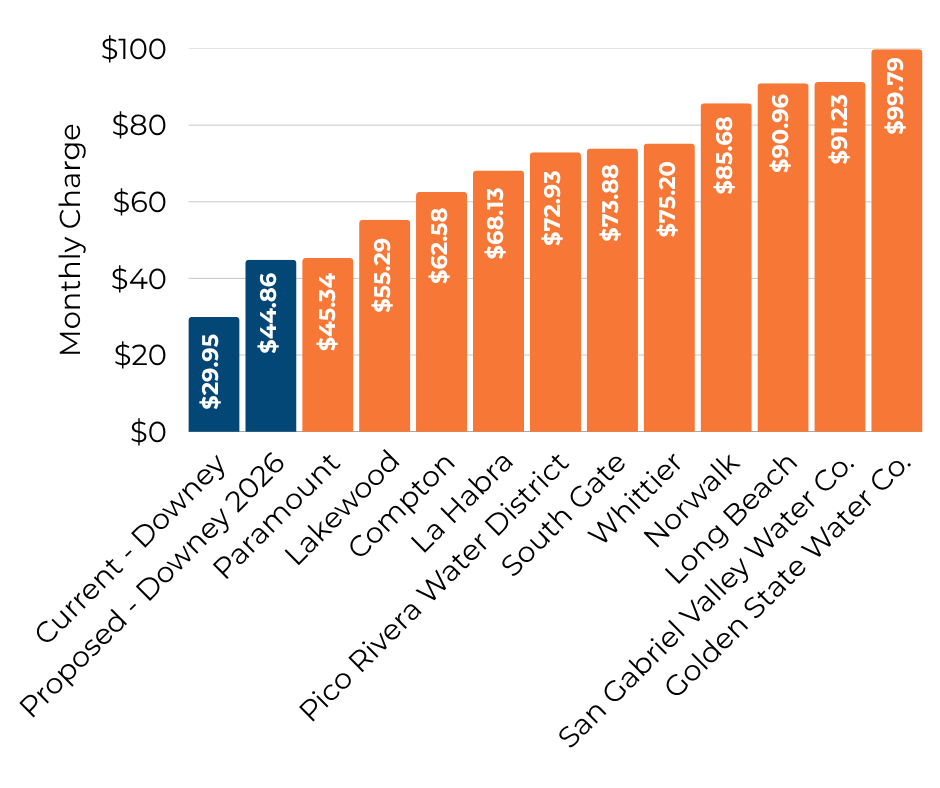
Single-Family Residential Monthly Water Bill Comparisons*
We want to hear your feedback.
The City Council will consider adopting the recommended rate changes at a public hearing on January 13, 2026, at 6:30 p.m. Before final rates are adopted, residents will have the opportunity to share feedback or file formal protests and/or objections.



Submitting a Formal Objection
Your written objection must clearly state why you believe the new rates violate Proposition 218 (the law that governs how local governments change utility rates). To be valid, the City Clerk must receive objections by 5:30 p.m. on January 8, 2026.
Providing a Formal Protest
If you are a property owner or tenant who is a City of Downey customer, you can protest the proposed water rates. Written protests must be received by 6:30 p.m. on January 13, 2026, before the conclusion of the Public Hearing.
Attend the Public Hearing
We encourage you to attend the public hearing on January 13 to share your input.
The public hearing will be held in the City Council Chambers, located at 11111 Brookshire Avenue, at 6:30 p.m. on January 13, 2026.
Review our Proposition 218 Notice for detailed protest and objection requirements.
You’re invited to learn more about the proposed changes at one of our community outreach events.

Webinar
Monday, December 8, 2025
6:30 p.m.

In-Person Event
Wednesday, January 7, 2026
6:30 p.m.
Barbara J. Riley Center
Frequently Asked Questions
-
The City of Downey owns and operates its own water system that serves over 23,000 customers. The system includes 19 groundwater wells, 3 imported water connections, 264 miles of potable and recycled water pipeline, 23,500 water meters, 5,800 isolation valves and 1,800 fire hydrants.
Local control lets us make repairs faster, deliver more reliable service, and guarantees that decisions are made by people who live and work in our community. The City’s in-house team is responsible for maintaining and delivering safe drinking water to every customer.
Reliability and safety are critical elements of the City’s water services. Delivering clean water requires constant care, expert management, and regular upgrades to prepare for everything from main breaks to climate events. Most of the maintenance happens away from public view but goes on around-the-clock.
Your water bill isn’t just paying for water; it’s an investment in a system that supports your health, comfort, and quality of life. Downey has a strong record of providing clean water, meeting all state and federal standards, but, like most water providers, the infrastructure is aging and new more stringent – and costly – regulations for water quality need to be met.
-
Downey has not raised its water rates since 2015. Over the past decade, the cost of providing service has grown significantly due to inflation, aging infrastructure, and new state and federal water quality regulations, especially requirements to address man-made chemicals called per- and polyfluoroalkyl substances (PFAS). The proposed increase will fund essential projects that keep our water system safe and reliable while addressing future financial sustainability.
-
A typical single-family household uses about 9,000 gallons of water each month. For the average household, the proposed rates would increase the monthly bill by $14.91 starting January 14, 2026. Since the City bills customers every two months (bi-monthly), the increase per water bill will be approximately $29.82. Smaller adjustments can be expected every year through 2030.
-
Downey’s last water rate increase took effect on July 1, 2015. Since then, costs for materials, power, labor, and construction have increased by more than 45%. The City did not increase rates for as long as possible, maintaining the lowest water rates in the region, but continued underfunding would threaten reliability and regulatory compliance. Even with the proposed increase, Downey residents will continue to pay a lower water rate than those in neighboring communities.
-
Key cost drivers for the next five years include:
PFAS treatment investments exceeding $127 million to meet new federal and state water quality standards.
Approximately $29 million in essential capital upgrades to address aging pipelines, wells, and pumps that have reached the end of their useful lives.
Installation of electric generators to keep water flowing during blackouts.
Inflation and higher energy, material, and construction costs.
Regulatory requirements for system resiliency, emergency backup power, and responsible reserve funding.
-
Revenue from the new rates will support:
Construction of PFAS treatment facilities.
Replacement of aging water mains, wells, and pumps.
Upgrades to system monitoring, emergency backup power for wells, and storage.
Building financial reserves required by the State Revolving Fund (SRF) loan program.
-
No. By law, the City can only charge customers the cost of providing service, and water utility revenues cannot be used to fund other City services or projects.
-
The rates are based on a professional cost-of-service analysis. The rates are based on the City’s projected costs to serve each type of customer. The process ensures fairness so that every customer pays only their proportional share of service costs. Detailed information is available in the Rate Study Report.
-
A rate study evaluates operating expenses, capital improvement needs, reserve targets, and funding sources over multiple years. A cost-of-service analysis then determines how those total costs should be fairly distributed among customer classes (residential, commercial, industrial, etc.), based on the costs each class places on the system.
-
The study was completed by Raftelis, an independent consulting firm that specializes in financial planning and rate setting for water and wastewater utilities. The process was reviewed by City staff and legal counsel to ensure accuracy and compliance with state law.
-
New PFAS limits will be enforced soon, and the City needs to comply. The PFAS treatment plant will support compliance with new regulations.
The City needs to plan for design of the plant now, which will cost about $10 million. Construction is planned to start in 2028 and will cost even more.The City engaged a third party to evaluate Downey’s water system and provide recommendations to help the City plan and budget for improvements to address PFAS compliance.
The City has discussed this project with the State Revolving Fund and plans to get a loan. The loan covers “shovel ready” projects. Shovel ready means the design drawings have been completed. The State also requires a debt service reserve as part of its loan covenant. These reserves were accounted for during the rate study and played a role in the recommended rate increases.
-
The City is pursuing a State Revolving Fund (SRF) loan to help finance PFAS treatment facilities, but most of the water system’s funding comes directly from customer rates.
When it borrows money from the State, the City signs a contract. That contract says the City must keep a certain amount of money in savings and bring in enough money to pay back the loan. Water rates are set to make sure these conditions are followed.
-
Residents can share feedback by contacting the City by email at WaterRates@downeyca.org.
-
Under Proposition 218, property owners or customers may submit written protests or objections before or during the public hearing. Instructions and deadlines are provided in the official notice mailed to all customers.
-
Customers can lower costs by saving water indoors and outdoors, fixing leaks quickly, and following the City’s seasonal watering guidelines. Conservation tips and resources are available on the City’s website and through the City’s water conservation programs.
Proposed Water Rates

Proposed Fixed Service Charges
A fixed service charge for both potable and recycled water customers that is based on the size of your water meter.
Click here to zoom in on table.
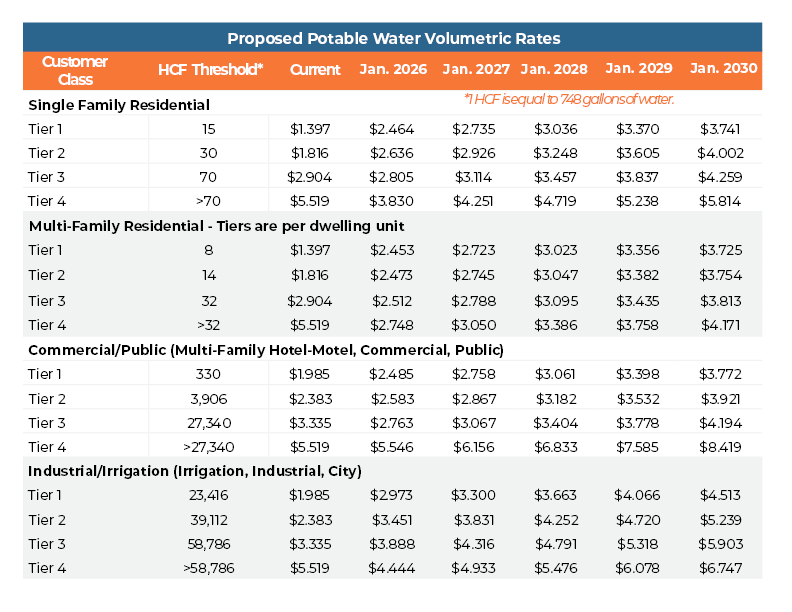
Proposed Potable Water Volumetric Rates
High water users place more significant demand (and higher costs) on the water system than low water users. Tiered volumetric rates ensure that those who use higher volumes pay the higher associated costs.
Click here to zoom in on table.
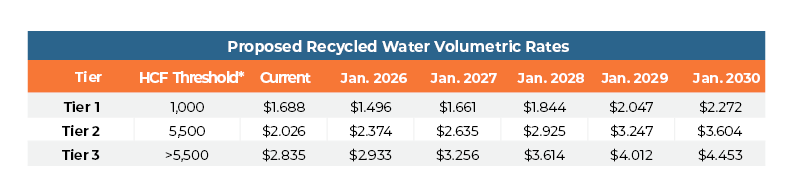
Proposed Recycled Water Volumetric Rates
These rates are only for customers who use recycled water.
Click here to zoom in on table.
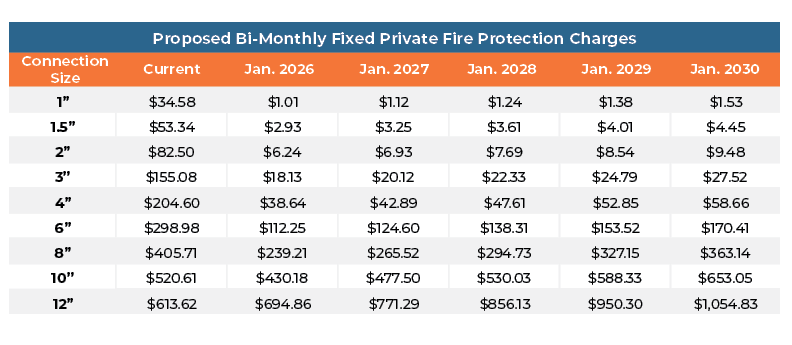
Proposed Private Fire Protection Charges
This charge is only for customers with private fire service lines, and is based on the size of the private fire service line.
Click here to zoom in on table.